
- 17/08/2026
- Dr. Pratik Patil
- 0 Comments
- Blog
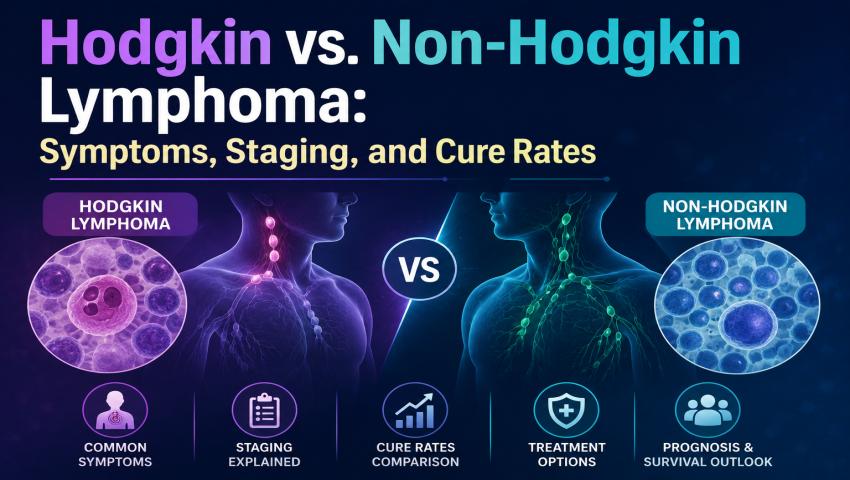
Hodgkin vs. Non-Hodgkin Lymphoma: Symptoms, Staging, and Cure Rates
Lymphoma is one of the most common blood cancers, and many people get confused between its two main types — Hodgkin lymphoma and Non-Hodgkin lymphoma. While both start in the lymphatic system and share similar symptoms, they behave very differently in terms of diagnosis, staging, and treatment outcomes. Dr. Pratik Patil, a leading Cancer Specialist in Pune, explains the key differences between Hodgkin lymphoma vs Non-Hodgkin lymphoma to help patients and families understand this condition better.
What Is Lymphoma?
Lymphoma is a type of blood cancer that begins in the lymphatic system — the network of lymph nodes, lymph vessels, and organs like the spleen and bone marrow that help the body fight infections.
There are two main types of lymphoma:
- Hodgkin lymphoma – a rarer type identified by a specific abnormal cell
- Non-Hodgkin lymphoma – a more common and varied group of over 30 subtypes
Lymphoma is often compared to leukemia, but the two are different — leukemia mainly affects the blood and bone marrow, while lymphoma affects the lymph nodes and lymphatic tissue. Both fall under the broader category of blood cancer.
What Is Hodgkin Lymphoma?
Hodgkin meaning, in simple terms, refers to a cancer named after Dr. Thomas Hodgkin, who first identified it in 1832. It is a relatively rare cancer that starts in the white blood cells called lymphocytes.
The defining feature of Hodgkin lymphoma is the presence of Reed-Sternberg cells — large, abnormal cells that doctors look for under a microscope during diagnosis. If these cells are found, the cancer is classified as Hodgkin lymphoma.
Quick facts about Hodgkin lymphoma:
- Less common than Non-Hodgkin lymphoma
- Usually starts in one lymph node area and spreads in an orderly pattern
- Most common in young adults (15–30 years) and adults over 55
- One of the most curable cancers when caught early
What Is Non-Hodgkin Lymphoma?
It is a group of blood cancers that start in the lymphatic system but do not show Reed-Sternberg cells. To define non-Hodgkin’s disease simply — it is a broader, more varied category of lymphomas that can develop in B-cells or T-cells and grow either slowly or aggressively.
Key points about Non-Hodgkin lymphoma:
- More common than Hodgkin lymphoma
- Includes over 30 different subtypes (such as diffuse large B-cell lymphoma and follicular lymphoma)
- Can spread unpredictably to different lymph node areas
- More commonly affects older adults, though it can occur at any age
Hodgkin vs Non-Hodgkin Lymphoma: Key Differences
Causes and Risk Factors:
The exact causes of Hodgkin’s disease and Non-Hodgkin lymphoma are not fully known, but certain factors increase the risk:
- Weakened immune system – due to HIV, autoimmune diseases, or organ transplant medicines
- Viral infections – such as Epstein-Barr virus (EBV) or Hepatitis C
- Age – young adults and older adults are at higher risk
- Family history – having a close relative with lymphoma
- Exposure to chemicals – certain pesticides and industrial chemicals
- Obesity – linked to a higher risk of Non-Hodgkin lymphoma
Symptoms of Hodgkin and Non-Hodgkin Lymphoma:
Both types of lymphoma often show similar early symptoms, which is why they’re easy to confuse without a proper diagnosis.
Common symptoms of lymphoma include:
- Swollen lymph nodes in the neck, armpit, or groin (usually painless)
- Persistent fatigue
- Unexplained weight loss
- Fever without any clear cause
- Drenching night sweats
- Itchy skin
- Chest pain, coughing, or shortness of breath (if lymph nodes in the chest are affected)
- Abdominal pain or swelling
These fever, weight loss, and night sweats symptoms together are medically referred to as “B symptoms” and play an important role in staging the disease.
Note: These are also early signs of lymphoma, so if any of these symptoms last more than 2 weeks, it’s important to consult a doctor for proper evaluation.
How Is Lymphoma Diagnosed?
Diagnosing lymphoma involves a few key steps:
- Physical examination – checking for swollen lymph nodes
- Blood tests – to assess overall health and detect abnormalities
- Imaging tests – CT scan, PET scan, or MRI to check the size and spread of lymph nodes
- Lymph node biopsy – the most important test; a small tissue sample is examined under a microscope to check for Reed-Sternberg cells
- Bone marrow biopsy – sometimes needed to check if the cancer has spread to the bone marrow.
The biopsy result is what confirms whether it is Hodgkin lymphoma or Non-Hodgkin lymphoma.
Staging of Lymphoma (Ann Arbor System):
Once lymphoma is confirmed, doctors use the Ann Arbor staging system to determine how far it has spread. This staging applies to both Hodgkin and Non-Hodgkin lymphoma.
Stage I & II:
- Stage I: Cancer is found in only one lymph node area
- Stage II: Cancer is found in two or more lymph node areas, but on the same side of the diaphragm (the muscle separating the chest from the abdomen)
Stage III & IV:
- Stage III: Cancer is found in lymph node areas on both sides of the diaphragm
- Stage IV: Cancer has spread beyond the lymphatic system to organs like the liver, lungs, or bone marrow
Doctors may also add letters to the stage:
- A – no B symptoms present
- B – B symptoms present (fever, weight loss, night sweats)
- E – cancer has spread to an organ near a lymph node
- X – bulky tumor (10 cm or larger)
Important: Even Stage III or IV lymphoma is often still treatable and, in many cases, curable — unlike advanced stages of many solid tumor cancers.
Cure Rates and Survival Rates:
1. Hodgkin Lymphoma:
2. Non-Hodgkin Lymphoma:
In short: Hodgkin lymphoma generally has a higher and more predictable cure rate, while Non-Hodgkin lymphoma’s outcome depends on the specific subtype and how early it is caught.
Treatment Options for Lymphoma:
Treatment depends on the type, subtype, stage, and the patient’s overall health. Common treatment options include:
- Chemotherapy – the most common treatment for both types of lymphoma
- Radiation therapy – often used for early-stage Hodgkin lymphoma
- Immunotherapy – boosts the immune system to fight cancer cells
- Targeted therapy – attacks specific proteins on cancer cells
- Stem cell transplant – used in cases where lymphoma returns after initial treatment
- Watchful waiting – for slow-growing subtypes that don’t need immediate treatment
When to Consult Medical Oncologist? Dr. Pratik Patil
You should see a specialist if you notice:
- Swollen lymph nodes that don’t go away after 2–3 weeks
- Ongoing, unexplained fatigue
- Unexplained weight loss
- Persistent fever or night sweats
Early diagnosis makes a significant difference in treatment success and cure rates for both Hodgkin and Non-Hodgkin lymphoma. If you or a loved one is experiencing these symptoms, it’s advisable to get a second opinion for cancer treatment from an experienced oncologist before starting treatment.
Conclusion:
Understanding the difference between Hodgkin lymphoma vs Non-Hodgkin lymphoma is important for early detection and better treatment outcomes. While Hodgkin lymphoma is less common but highly curable, Non-Hodgkin lymphoma is more common, with outcomes that vary by subtype. In both cases, early diagnosis and the right treatment plan make all the difference.
Dr. Pratik Patil, a trusted Cancer Specialist in Pune and Medical Oncologist at Jupiter Hospital, Baner, has extensive experience in diagnosing and treating all types of lymphoma. If you or someone you know is showing symptoms of lymphoma, consult Dr. Pratik Patil for accurate diagnosis, staging, and a personalized treatment plan.
FAQs about Hodgkin vs. Non-Hodgkin Lymphoma:
The main difference lies in the cells found during diagnosis. Hodgkin lymphoma is identified by the presence of Reed-Sternberg cells — large, abnormal cells seen under a microscope during a biopsy. Non-Hodgkin lymphoma lacks these cells and instead includes over 30 different subtypes that can develop in B-cells or T-cells. Dr. Pratik Patil explains that this distinction is critical because it directly influences how the cancer is staged, treated, and how it’s expected to respond to therapy.
The exact cause of Hodgkin’s disease isn’t fully understood, but several risk factors are known to increase the likelihood of developing it. These include a weakened immune system (due to conditions like HIV or long-term use of immunosuppressant medicines), infection with the Epstein-Barr virus (EBV), having a close family member with lymphoma, and being in the younger (15–30 years) or older (55+) age groups. According to Dr. Pratik Patil, most patients with Hodgkin lymphoma have no identifiable cause, which is why regular checkups are important if symptoms like swollen lymph nodes persist.
In most cases, yes. Hodgkin lymphoma has one of the highest cure rates among all cancers, with an overall 5-year survival rate of around 88%, rising to 92–95% when caught in the early stages. Non-Hodgkin lymphoma’s cure rate is more variable, ranging from around 40% to 74% depending on the specific subtype, since it includes both slow-growing and aggressive forms. Dr. Pratik Patil notes that even within Non-Hodgkin lymphoma, many subtypes respond very well to modern treatment when diagnosed on time.
The most common early symptom is a painless, swollen lymph node — often in the neck, armpit, or groin — that doesn’t go away after a few weeks. Other symptoms include persistent fatigue, unexplained weight loss, low-grade fever, drenching night sweats, and occasionally itchy skin. Dr. Pratik Patil advises that these symptoms are easy to mistake for common infections, which is why any lymph node swelling lasting more than two to three weeks should be evaluated by a specialist rather than self-treated.
Lymphoma is staged using the Ann Arbor staging system, which ranges from Stage I to Stage IV based on how many lymph node areas are affected and whether the disease has spread beyond the lymphatic system. Stage I means the cancer is limited to one lymph node area, while Stage IV indicates it has spread to organs such as the liver, lungs, or bone marrow. Dr. Pratik Patil uses this staging, along with imaging tests and biopsy results, to design a personalized treatment plan for each patient.
Yes, in many cases stage 4 lymphoma can still be treated effectively and even cured, especially with today’s advanced treatment options like chemotherapy, immunotherapy, targeted therapy, and stem cell transplants. Unlike many solid tumor cancers, lymphoma tends to remain responsive to treatment even at advanced stages. Dr. Pratik Patil emphasizes that a stage 4 diagnosis should not be seen as a hopeless situation — outcomes depend heavily on the lymphoma subtype and how well the patient responds to therapy.
Diagnosis typically starts with a physical examination to check for swollen lymph nodes, followed by blood tests and imaging scans such as a CT or PET scan. The most important step is a lymph node biopsy, where a tissue sample is examined under a microscope to check for Reed-Sternberg cells, which confirm whether it’s Hodgkin or Non-Hodgkin lymphoma. Dr. Pratik Patil, a Cancer Specialist in Pune, recommends getting a biopsy done as early as possible once lymphoma is suspected, since early diagnosis significantly improves treatment outcomes.